EEG-Based UX/UI Design Studies: A Systematic Review
Purpose: To examine how EEG is used in UX/UI evaluation and to identify its applications, limitations, and future directions.
Methods: A systematic review of 21 studies (2014–2024), structured using the PICO framework.
Insight: Identified key trends, limitations, and future opportunities in EEG-based UX/UI evaluation.
Background
Limitations of Traditional UX/UI Evaluation
- Traditional UX/UI metrics (performance, issue-based, self-reported, biological&physiological)
- Focus on observable behavior and self-reports
- Limited understanding of users' internal states

Fig. 1. UX/UI metrics (performance, issue-based, self-reported, biological)
Growing Complexity of UX/UI
- Expanding domains (VR, automotive, PUI, robotics, communication)
- Increasing need for real-time interaction and feedback
- More complex systems → Need for multi-metric evaluation

Fig. 2. UX/UI domains
" Difficulty in objectively measuring users' internal states in UX/UI evaluation "
Table 1. Physiological Measurement Comparison
| Criteria | EEG | fNIRS | fMRI | fEMG | ECG/HRV | GSR/EDA | Eye-tracking |
|---|---|---|---|---|---|---|---|
| Primary signal | Brain activity | Brain blood flow | Brain blood flow | Muscle activity | Heart activity | Skin conductance | Gaze |
| Temporal resolution | High | Medium | Low | High | High | High | High |
| Spatial resolution | Low | Medium | High | Low | Low | Low | Medium |
| Invasiveness | Low | Low | Medium | Low | Low | Low | Low |
| Mobility | Medium | High | Low | High | High | High | High |
| Setup complexity | Medium | Medium | High | Low | Low | Low | Low |
Advances in Physiological Measurement
- Increasing use of physiological signals for objective UX/UI evaluation
- Captures users' internal states beyond observable behavior
- Modalities: EEG, fNIRS, fMRI, fEMG, ECG/HRV, GSR, eye-tracking
EEG in UX/UI Interaction
- Captures brain activity during user interaction processes
- Enables analysis of rapid, dynamic changes during interaction
- Applicable to interactive and real-time UX environments
" EEG offers a balance between temporal resolution and practical applicability for analyzing dynamic user responses "
Research Objective
" To systematically review EEG-based UX/UI evaluation studies, identify key insights into user responses, and examine limitations and future directions. "
Method
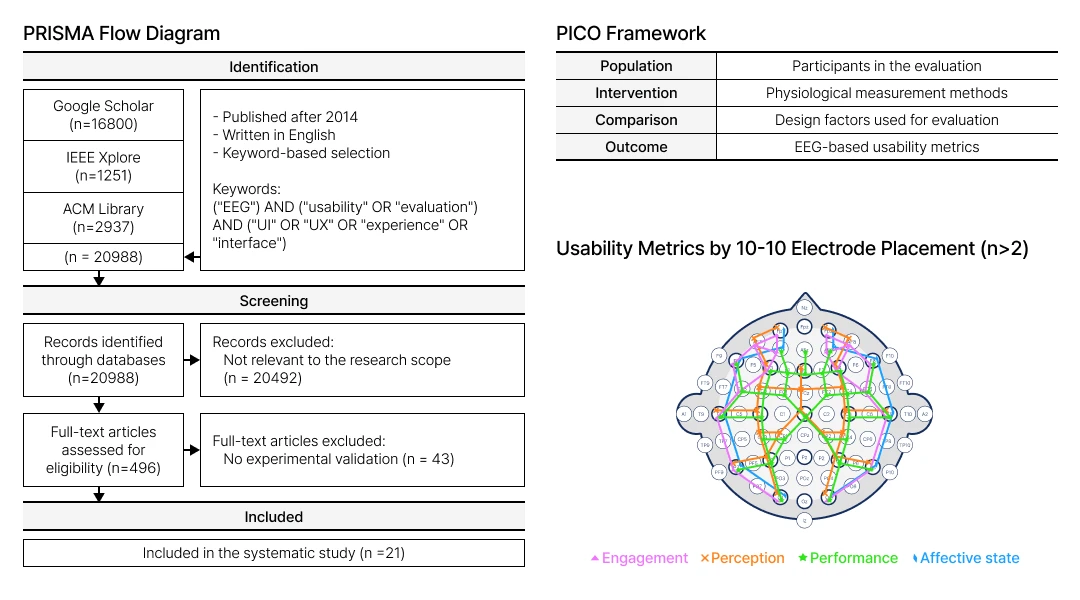
Study Selection (PRISMA)
- Studies were collected from Google Scholar, IEEE Xplore, and ACM Digital Library
- Keywords: "EEG" AND ("usability" OR "evaluation") AND ("UI" OR "UX" OR "experience" OR "interface")
- Publications between 2014 and 2024 were considered
- A total of 21 studies were included after the screening process
Analysis Framework (PICO)
- Population: Participants in UX/UI evaluation studies
- Intervention: EEG-based measurement and analysis
- Comparison: Different UI/UX designs or interaction conditions
- Outcome: Usability metrics (e.g., user responses, performance, experience)

Fig. 3. Study selection (PRISMA) and analysis framework (PICO)
Research Trends
Cognitive & Multimodal Trend
- Cognitive evaluation trend ↑
(Cognitive > Emotion > Immersion > Performance) - Predominance of EEG-only approaches
- Multimodal & VR/HMD-based approaches ↑

Fig. 4. UX Dimensions × Methodological Choice

Fig. 5. Publication Year × Methodological Trend
Practical EEG System Trend
- Low-Mid Channel (1–16ch) ↑
High Channel (32ch+) ↓ - Lightweight & practical EEG systems ↑
- High-channel EEG + multimodal & immersive environments
- 2D UI: Low-Mid Channel, Cognitive ↑
- 3D UI: Mid-High Channel, Cognitive & Immersion ↑
- Hardware: Mid-High Channel, Emotion & Cognitive ↑

Fig. 6. Electrode Count Distribution × Methodological Choice
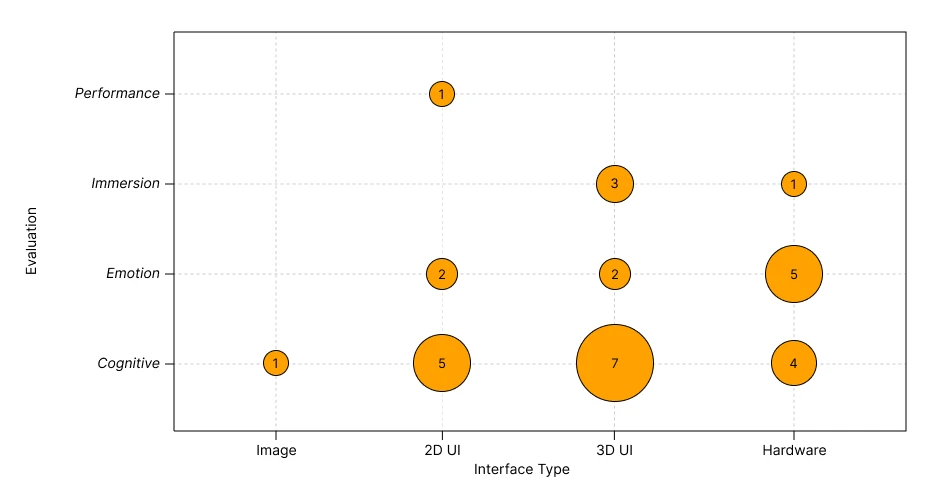
Fig. 7. Interface Type × Evaluation Dimension
EEG Analysis Trend
- Predominance of frequency-domain approaches in UX/UI
- ERP-based approaches in controlled interaction analysis
- Time-frequency & machine learning approaches ↑
- Adaptive & real-time UX research ↑
Table 2. EEG Analysis Categories in UX/UI Research
| EEG Analysis Category | Description |
|---|---|
| Frequency-domain Analysis | Analysis of EEG activity across frequency bands |
| ERP-based Analysis | Analysis of event-related neural responses during interaction |
| Time-frequency Analysis | Analysis of temporal changes in EEG dynamics over time |
| Machine Learning-based Analysis | Data-driven interpretation and classification of EEG patterns |
Experimental Environment Trend
- Controlled laboratory environment predominance
- XR/HUD & immersive environment studies ↑
- Limited real-world EEG evaluation studies
- Potential for wearable EEG applications ↑
Conclusion
Key Insights
- Predominance of cognitive-centered EEG evaluation & EEG-only approaches
- Diverse UX dimensions & multimodal methods ↑
- VR/XR & immersive environment–based UX research ↑
- Portable & practical EEG systems → dynamic and real-time UX evaluation
Limitations & Challenges
- Sensitivity to motion artifacts & environmental noise
- Variability of EEG responses across individuals
- Limited ecological validity in controlled laboratory settings
- Challenges in stable EEG acquisition during real-world interaction
- Lack of standardized protocols for EEG-based UX/UI evaluation
Future Opportunities
- Adaptive and real-time neuroergonomic UX systems
- Multimodal & AI-driven user state interpretation
- Wearable EEG for real-world interaction analysis
- Expansion toward XR, automotive, robotics, and intelligent human-centered systems