Adaptive Automotive Headrest for Shared Vehicles
Problem: Privacy invasion and discomfort from non-personalized seating in shared vehicles
Solution: An adaptive headrest enabling visual shielding and personalized ergonomic support
Background
Rise of Shared Vehicles
- Shift from vehicle ownership to shared use
- Market projected to reach ~$86.9B by 2029
Changing In-Vehicle Experience
- Vehicles expanding into personal spaces
- Growing demand for personalized experiences
Limitations of Existing Seating
- Lack of visual privacy from other passengers
- Insufficient adaptation to individual posture and body type
User Research
Activities
Various usage patterns such as resting, working, and sleeping
Posture
Continuously changing postures depending on head support
Environment
Close proximity to unfamiliar passengers in a shared space

Fig. 1. User activities and postures in shared vehicle environments
" Users require both personal space and stable physical support "
Problem
Psychological Discomfort
Side exposure to others' gaze → lack of privacy
Physical Fatigue
Fixed seat structure → lack of personalized support
Goal
" To provide personal space through gaze blocking and adaptive physical support "
Design
Partial Visual Shielding with Soft-Fin Ray Structure
- Forms lateral visual barriers using flexibility and resilience
- Enables psychological comfort while maintaining situational awareness

Fig. 2. Soft-Fin Ray–based visual shielding mechanism
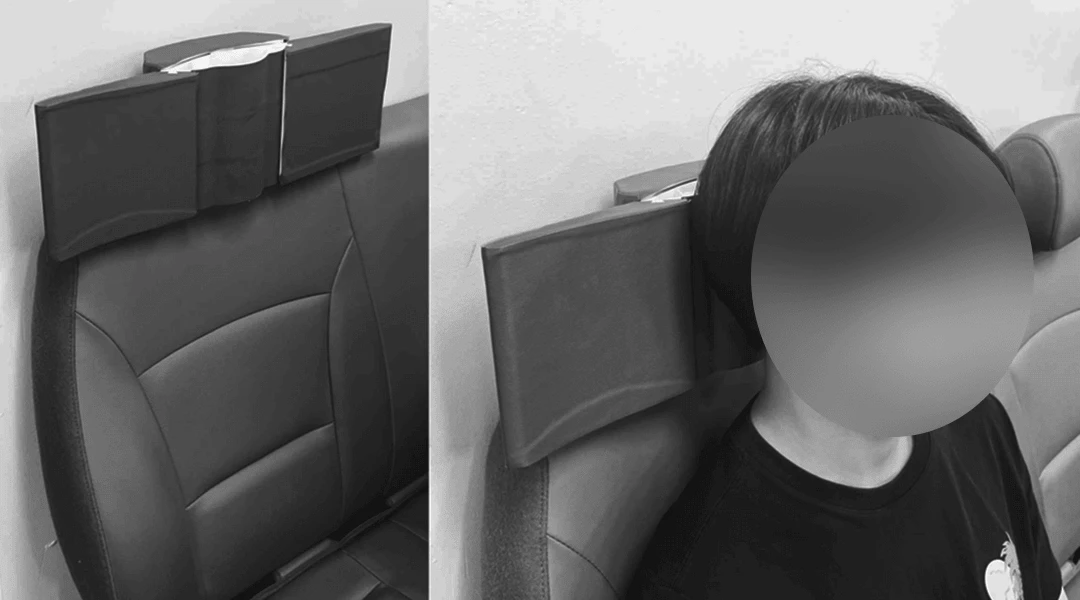
Behavior-Driven Interaction
- Head-leaning pressure naturally triggers visual shielding
- Leverages user behavior during rest or personal activities

Fig. 3. Head-leaning interaction for natural visual shielding
Adjustment Mechanism
- Locking system allows use only when needed
- Provides intuitive position control

Fig. 4. Adjustable locking mechanism for position control
Compatibility with Existing Headrests
- Utilizes standard headrest bar structure
- Enables easy installation without modification

Fig. 5. Prototype integrated with existing vehicle headrest
Results
" Structural stability, safety, and real-world applicability validated "
Static & impact simulations
- Lower deformation indicates high structural stability
- Low stress at the head-contact area ensures user safety
- Minimal deformation and stable stress distribution under impact
Table 1. Static Load Analysis Results
| Material | Max Deformation (mm) | Max Stress (kPa) | Stress at Head Contact Area (kPa) |
|---|---|---|---|
| ABS | 4.26 | 11,600 | 0.17 |
| Stainless Steel | 0.04 | 12,400 | 0.22 |
Table 2. Dynamic Load Analysis under Rear Impact
| Parameter | Value |
|---|---|
| Impact Duration | 0.01 s |
| Impact Momentum | 83.35 kg·m/s |
| Applied Force | 8,335 N |
| Max Deformation | 7.58 mm |
| Max Stress | 2,488,500 kPa |
| Stress at Head Contact Area | 19.26 kPa |

Fig. 6. Simulation Results: Impact, Deformation, and Stress Distribution
Prototype integration
- Prototype integrated with vehicle seat
- Real-world feasibility demonstrated
Fig. 7. Prototype integrated with vehicle seat